You have the data and the plan. STPO lets you apply it precisely: time and space cues set each level, the athlete self-corrects into flow, and holds it for every rep and every set.
Just like you plan strength with weights: game-speed progressive overload, at your fingertips.
STPO is a way to set the dose of speed work from outside, at the athlete's own level, and to raise it in small steps. It is far more than step timing.
One clip from a phone, or your Optojump file. We read the time and space of the current performance.
We set the tailored progression: cues on time, marks on space, at the athlete's level and on your plan.
3-in-1 drills. The athlete self-corrects on the fly. Your tools check prescribed against done.
Optojump tells you, to the millisecond, what happened on every step. With STPO you apply the next rep, and your whole planned progression, precisely: the athlete hits each level on the cue. Optojump checks it. No new hardware.
See how they work togetherA national-level 800 m runner, first session. Rep 1: 263 ms a step, 4 % ahead of the planned rhythm. Minute 19: 272, within 1 % of the plan. Nobody counted out loud: the rhythm coached, and she corrected herself, rep after rep.
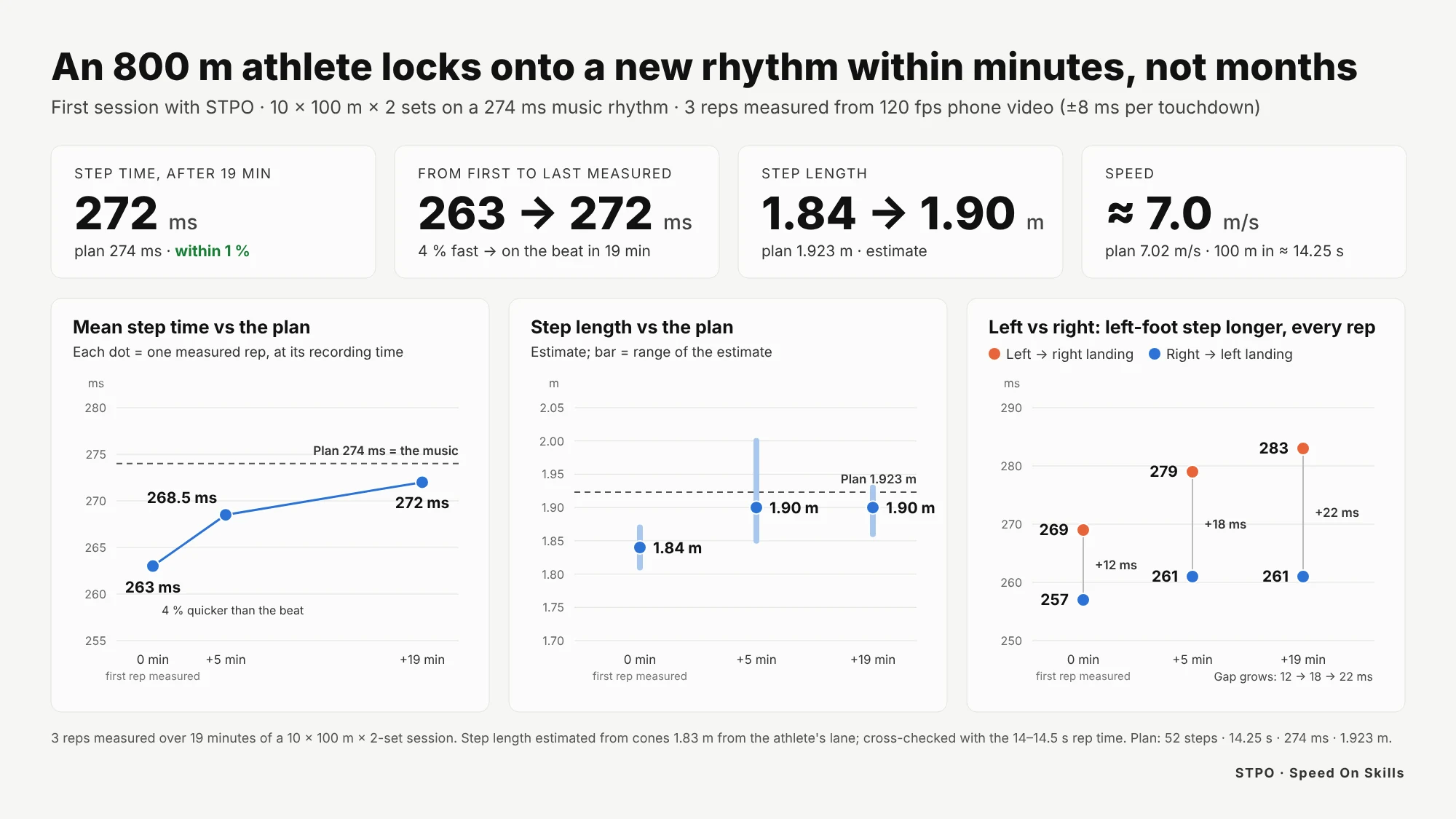
And what no stopwatch sees: the step from her left foot lasts longer than from her right, and the gap grows with fatigue: 12 → 18 → 22 ms.
In the 1960s, Yury Verkhoshansky's shock method, the depth jumps that became plyometrics, looked strange. More than fifty years later it is in every strength and conditioning program, and still studied in 2026. In 1997 the same man wrote about STPO's roots: "a very good idea". Thirty years on, the tech has caught up: in 2026 a phone measures what the method has always done.
Meet the author: carlobressan.com →